Install RVM in your Ubuntu Desktop
Sep 15, 14 by Juan Lebrijo about ruby, RVM, blog
You can install RVM with this few commands:
sudo apt-get install curl
curl -L get.rvm.io | bash -s stable --auto
source /etc/profile.d/rvm.sh << or whatever says the console of rvm >>
After that, you need to check which RVM prerequisites depends on :
rvm requirements
Install last ruby version:
rvm install 2.1.2
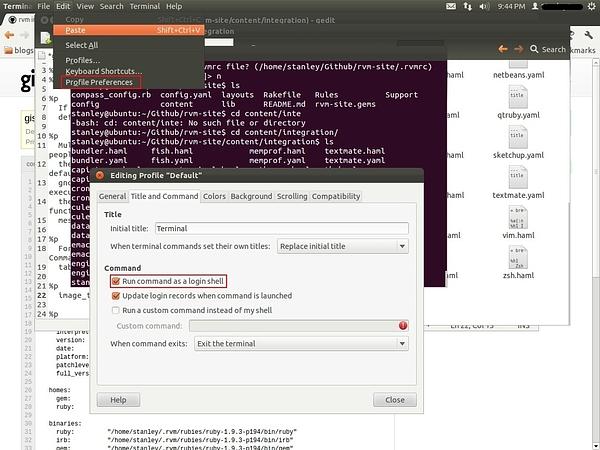
For .bashrc executing purposes, and execute RVM ruby version when open a project, you can integrate RVM with your Gnome terminal:
rvm-gnome-terminal-integration.jpg 140 KB
Deeper explanation here: https://rvm.io/integration/gnome-terminal/ My favourite way to configure a Rails project ruby-version and gemset is in Gemfile:

#ruby=ruby-2.1.2 #ruby-gemset=website

But you always you can use .ruby-version and .ruby-gemset files.
Chef basics for Rails Developers
Sep 13, 14 by Juan Lebrijo about ruby, chef, gotealeaf, vagrant, capistrano, blog
In our new collaboration with Tealeaf Academy friends, we are writing about Chef/Vagrant and how to use them to manage and test your servers configuration. This is a step-by-step guide (including github projects) to bootstrap and cook a basic Rails server:
  • Step 1. Vagrant: Creating your Development environment (Server Virtualization)
  • Step 2. Knife-solo: Kitchen structure
  • Step 3. Librarian: Managing dependencies
  • Step 4. Creating your own cookbook (rails-stack)
  • Step 5. Cook your Vagrant Box
  • Step 6. Cook a real server
  • Step 7. Deploy with Capistrano
  • Conclusions
Enjoy!!
Docker vs Vagrant
Sep 11, 14 by Juan Lebrijo about docker, scalability, vagrant, blog
Thanks to a question of my friend Xavier: "Is this something that might potentially interest us? CoreOS Now Available On DigitalOcean!", I reopened this internal discussion "Vagrant or Docker, this is the question?". Well here are my thoughts .... CoreOS is a minimal Linux Distro in order to save RAM when you manage Clusters (or slices within a machine). They promise  to use only 144MB RAM. When you use Docker, you need a host OS in your Server (CoreOS promises to be the lighter host OS). So the question here is ...... should we use Docker?
  • SERVER SIDE:
    • Docker/CoreOS are scalability tools: as Adrian said this is a really powerful tool to scale applications, you can deploy packaged containers (slices) within a server and among servers in a farm. CoreOS seems to help a lot at this point also, running 'etcd' by default.
    • Removes Lock-in: You can move your apps among providers (DO, Rackspace, AWS, Linode,... your private farm). Once you have your container configured, you just need to have a linux host (an AWS linux AMI, Ubuntu, CoreOS ....) with Docker installed.
  • DEVELOPER SIDE: Docker instead of Vagrant to emulate the system locally (take a look at this great discussion between both creators)
    • This is only possible, for the moment, if your app servers are linux (this does not mean that your Dev workstation should be Linux)
    • Docker engine (Virtualization layer) is based on LXC, which manages chroot, network, mount... all kernel "Containerizing" capabilities directly. This efficiency is extreme if your local OS is Linux.
      • Vagrant lies over VirtualBox which creates a lot of CPU and Memo overhead.
    • Portability: Docker allows to reproduce EXACTLY the production scenario in your workstation (or other environments like staging or testing). You just need Docker/Linux installed in both, and Docker acts as an abstraction layer.
      • Vagrant offers images which haven't the same configuration as your provider's images (I experienced this directly: ubuntu-14.04 has not the same configuration in vagrantcloud.com's box, and DigitalOcean.com's image)
    • Images weight: Vagrant boxes are much larger than Docker repos (ubuntu/trusty is ~600MB image box, against 64MB as Docker repo)
I was until this weekend with an eye on this Infrastructure Maintenance Stack:
  • Chef: Manages server installation and future configurations.
  • Vagrant: reproduces (approximately) our production server in order to check configurations.
  • Capistrano: Manages continuous deployment.
But due to read (and tests) about Docker this weekend, I am thinking to substitute Vagrant per Docker (the reasons above are really persuasive). So, hey guys!! what do you think? Is Docker/CoreOs something that might potentially interest us?