Jun 21, 10 by Juan Lebrijo about arquitechture, weblogic, blog
Este post tiene su origen en el anterior de definición genérica de una Arquitectura para el desarrollo de Aplicaciones Web.
Basándome en la documentación de Oracle, investigando por internet, y tratando de ver cual es la situación más realista, os propongo la siguiente arquitectura basada en WebLogic:
arqo-oracle1.jpg76 KB
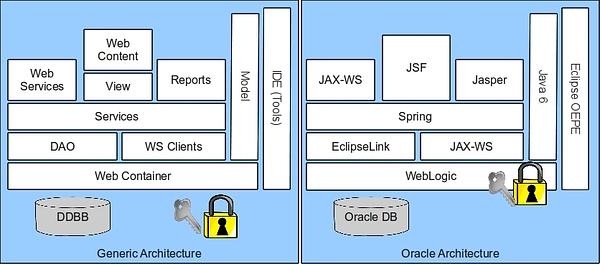
En la figura vemos la estructura genérica enfrentada a la concreta de Oracle:
JSF: en la capa de presentación para estructurar con MVC, y tratar de evitar el Javascript con los problemas de crossbrowsing.
Jun 21, 10 by Juan Lebrijo about arquitechture, weblogic, blog
This post comes from the last, which treats my generic definition for a Web Applications Development Architecture.
Taking basis in Oracle documentation, investing on internet, and searching the most realistic situation for an enterprise environment, I purpose the following architecture WebLogic based:
arqo-oracle1.jpg76 KB
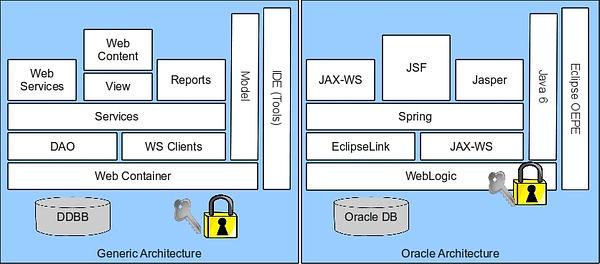
The figure shows the generic architecture against Oracle's one:
JSF: MVC on presentation layer, wanting to avoid javascript and crossbrowsing.
Jun 19, 10 by Juan Lebrijo about arquitechture, blog
After long time without posts, and huge not very regular, I have wash up the blog, and mainly to my profesional objectives.
In the following posts I will try to define a enterprise web applications architecture development (big data volume, mixed developers, big servers, grid,...) and an enterpreur architecture (low cost, agile development and fast, escalable,...).
I will adopt in the beginning the Java technologies, and I will construct each box of the map with the technologies I have learn:
arqo.png46.9 KB
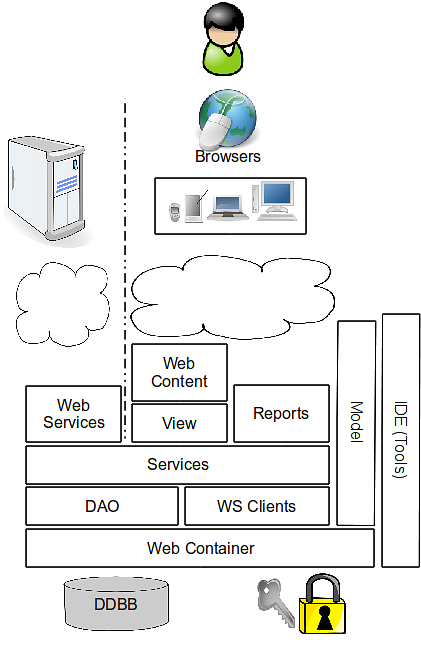
There will be two clients: user trough browsers, and other apps which consumes my Web Services. To the users I must serve functional pages and reports.
Below I find other layers:
Services: Business logic layer, here we convert the objects in order to show or persist them.
DAO: Data Access layer, manage the CRUD operations for our objects in our store.
Web Container: this the apps server, gets the common services between apps (JEE)
BBDD: data store
Security: security store
Model: application data model
In the other side we get the Development Environment, which will be a group of tools that help us to develop all the things above.
Here I define the general architecture mode, after I will fill with concrete technologies.